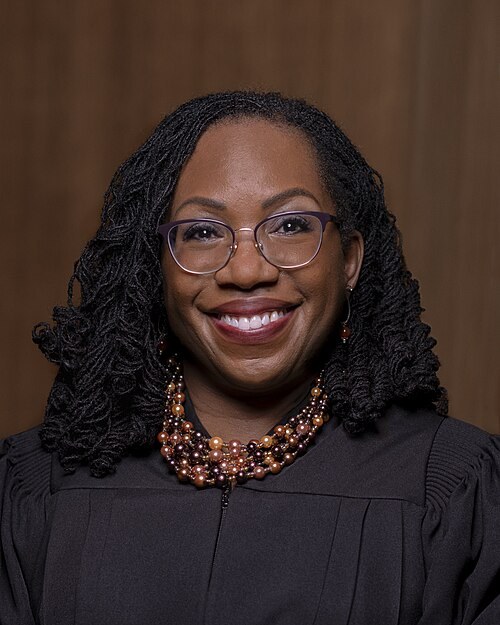
Jackson joined the Court in 2022 after serving on the federal district court and D.C. Circuit. Her earlier work included federal public defense and service on the U.S. Sentencing Commission.
An appointed, life-tenured judicial office. Decisions reflect legal judgments in particular cases.
Her separate Trump dissent examines presidential accountability through constitutional structure and the traditional framework of individual legal responsibility. Her Rahimi concurrence also discusses how courts apply historical tests. These are case-based illustrations, not a comprehensive ideological score.
This is a description of interpretive methods, illustrated by opinions below. It is not a party label or a prediction of every vote.
The Court affirmed the preliminary-injunction ruling against Alabama’s map, applying the established vote-dilution framework under Section 2. The decision concerned the specific record and did not require proportional representation nationwide.
5–4 · Kavanaugh joined the judgment and the opinion except Part III–B–1. This summary describes the 2023 decision, not later litigation over Alabama’s maps.
The Court held that the First Amendment barred compelling the custom expressive speech at issue. The ruling addressed the stipulated expressive services, not a general exemption from all public-accommodation laws.
The Court rejected Rahimi’s facial challenge to the federal firearm restriction at issue. It explained that historical analogies need not be exact replicas, while retaining Bruen’s history-based framework.
The Court recognized absolute immunity for conduct within exclusive constitutional authority, presumptive immunity for other official acts, and no immunity for unofficial acts. It remanded for application of that framework.
6–3 · Barrett joined the Court’s opinion except Part III–C, concerning use of official-act evidence. Sotomayor’s dissent was joined by Kagan and Jackson; Jackson also wrote separately.
“To the extent that the majority’s new accountability paradigm allows Presidents to evade punishment for their criminal acts while in office, the seeds of absolute power for Presidents have been planted.”
Trump v. United States Dissenting opinion · 2024-07-01
Jackson warns about the accountability consequences of the majority’s immunity framework.