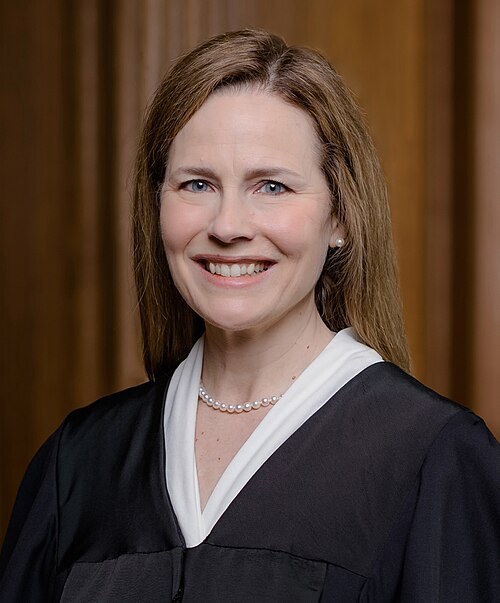
Barrett joined the Court in 2020 after serving on the Seventh Circuit. Before becoming a judge, she was a Notre Dame law professor and clerked for Justice Antonin Scalia.
An appointed, life-tenured judicial office. Decisions reflect legal judgments in particular cases.
Her Rahimi concurrence explains originalism while cautioning against treating every old regulation as a rigid template. She distinguishes a provision’s original meaning from the particular applications people expected at the time.
This is a description of interpretive methods, illustrated by opinions below. It is not a party label or a prediction of every vote.
The Court upheld Mississippi’s abortion restriction by a 6–3 judgment. Five justices overruled Roe and Casey and held that the Constitution does not confer a right to abortion, returning regulatory authority to elected governments.
6–3 · Roberts concurred only in the judgment: he would uphold the Mississippi law without overruling Roe and Casey. Overruling those precedents was 5–4, not 6–3.
The Court invalidated New York’s proper-cause requirement and adopted a text-and-historical-tradition framework for Second Amendment challenges. It did not invalidate every licensing condition or every firearm regulation.
The majority treated the challenged prayer as private religious expression protected by free exercise and free speech. The dissent disputed the majority’s factual framing and stressed students’ exposure to religious pressure.
6–3 · Sotomayor’s dissent was joined by Breyer and Kagan. Kavanaugh joined the Court’s opinion except Part III–B.
The Court affirmed the preliminary-injunction ruling against Alabama’s map, applying the established vote-dilution framework under Section 2. The decision concerned the specific record and did not require proportional representation nationwide.
5–4 · Kavanaugh joined the judgment and the opinion except Part III–B–1. This summary describes the 2023 decision, not later litigation over Alabama’s maps.
The Court held Harvard’s challenged admissions program unlawful. Applicants’ discussions of how race affected their lives may still be considered for individual qualities, but institutions may not recreate the rejected racial preferences indirectly.
6–2 · Harvard was 6–2 because Jackson did not participate. In the separately decided UNC companion case, the vote was 6–3 and Jackson participated. Jackson’s participation in UNC does not apply to Harvard.
The Court held that the First Amendment barred compelling the custom expressive speech at issue. The ruling addressed the stipulated expressive services, not a general exemption from all public-accommodation laws.
The Court overruled Chevron and held that courts must exercise independent judgment on statutory meaning under the Administrative Procedure Act. Existing holdings upholding particular agency actions were not automatically overturned.
6–2 · Loper Bright was 6–2: Jackson did not participate. She joined Kagan’s dissent only in the Relentless companion case, where the vote was 6–3.
The Court rejected Rahimi’s facial challenge to the federal firearm restriction at issue. It explained that historical analogies need not be exact replicas, while retaining Bruen’s history-based framework.
The Court recognized absolute immunity for conduct within exclusive constitutional authority, presumptive immunity for other official acts, and no immunity for unofficial acts. It remanded for application of that framework.
6–3 · Barrett joined the Court’s opinion except Part III–C, concerning use of official-act evidence. Sotomayor’s dissent was joined by Kagan and Jackson; Jackson also wrote separately.